Theory
Jacques Lacan and Lacanian Psychoanalysis
Lacan's return to Freud: the unconscious structured like a language, the Name of the Father, and the Imaginary, Symbolic and Real.
 Prof. Dr. Ali KeyvanPsychiatrist and Psychotherapist · Updated: 28 June 2020

Psychoanalysis is one of the most contested theoretical fields of the 20th century. From Freud’s earliest work onwards, its theoretical status was repeatedly called into question: is psychoanalysis a science, and if so, how can it be grounded as one, that is, established on an epistemological level? Yet psychoanalysis’s account of consciousness and the unconscious changed the course of an entire philosophical debate, especially debates about knowledge. Even so, the question of its status remained controversial, and Freud’s successors tended to develop psychoanalysis in the direction of “ego psychology” rather than tackling these problems.
Jacques Lacan and Lacanian psychoanalysis
Lacan’s starting point is a re-evaluation of this theoretical status and of its epistemological foundations. Throughout his work, Freud tried to address these theoretical problems, and this search for method is especially visible in his early writings. However, despite the important distinctions he drew, he could not fully escape the positivist–empiricist framework that dominated the science and philosophy of his day. Still, it must be said that Freud tried to ground psychoanalysis theoretically as a science, especially in the epistemological sense, and took important steps towards this. Lacan is above all a follower and defender of these steps. He presented himself as a defender of Freud, particularly against those currents in psychiatry that abandoned or denied Freud’s theoretical advances after him. For Lacan, “ego psychology” was an unacceptable direction.

We can say that Lacan keeps his distance from the id–ego–superego model. He is more closely connected with what might be called the “early” Freud, the Freud concerned with the structure, formation, place and workings of the unconscious, because for Lacan psychoanalysis, as a science, is “the science of the unconscious”. If Lacanian psychoanalysis is to be a science, it must first ground its own distinctiveness epistemologically, that is, it must define its object. Here Lacan takes as his theoretical basis the understanding of science that developed after positivism and empiricism, and rereads Freud accordingly. On this reading, the object of psychoanalysis (as Freud pointed to in many places but never made fully explicit) is the unconscious. This is a theoretical object, and, to distinguish psychoanalysis from other sciences, Lacan holds that the unconscious is a unique theoretical object. As Althusser noted in one of the early essays on Lacan, this is Lacan’s “return to Freud”, which brings Freud onto a new plane (see “Freud and Lacan”). Through this return, Freud, and with him psychoanalysis, can be freed from the limits and problems of the time of its birth and properly re-evaluated.
This means that the object in question, the unconscious, cannot be studied or explained with methods or concepts based on biology or sociology. Psychoanalysis emerges here as a theoretical necessity and must therefore be grounded theoretically from this point on. Lacan’s categorical insistence on Freud’s theoretical work, and his rejection of the classical psychiatric tradition, relate first and foremost to this point. Lacan approaches psychoanalysis through structuralism, and particularly through structural linguistics, and this orientation first appears in his account of how psychoanalysis should be understood as a science. The same linguistic model is then followed in his treatment of its object, the unconscious. As a result, Lacan’s rereading of Freud often looks, from the standpoint of traditional psychiatry, like a form of anti-psychiatry.
The unconscious and language
Lacan says that “the unconscious is structured like a language”. This formulation is a very concise expression of his theoretical work and of his attempt to reconstruct psychoanalysis. The language meant here is language as structural linguistics explains it. In the structuralist model, language is a unique structure or system that determines meanings through its own internal distinctions and so creates meaning. Distinctions of meaning are determined solely by the distribution and roles of the elements within the linguistic structure or system. In other words, language is a system of signs with no external reference. Applying this to psychoanalysis, Lacan concludes that the unconscious, just like language, is a structure or system of its own.
The unconscious has no essential connection with the external world; it is a kind of system of signs that determines distinctions of meaning through its own internal elements. As Althusser put it, “Lacan thinks of the linguistic sign and the psychoanalytic ‘symbol’ as the same thing”. Language carries social life and culture, and with them the laws and prohibitions that express them. Through language, that is, through the symbolic system, the human infant enters the cultural order at a stage when it is not yet aware of anything and cannot decide anything. It is shaped by this order (the symbolic), internalises its most basic values and elements, and in this way takes its first steps towards becoming human. The passage into the symbolic system of language is the same as the passage into the cultural order. In this transition from biological creature to thinking being, the individual subject is encoded as a cultural code.
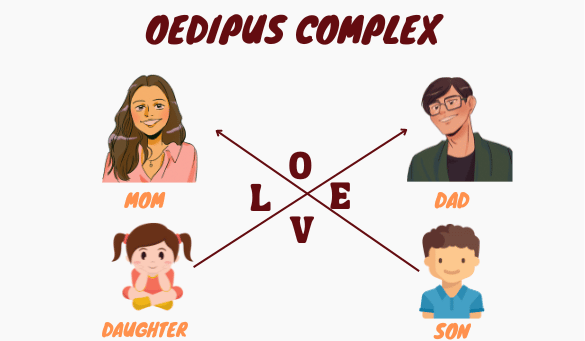
Through language, the subject finds itself marked as a signifier in the symbolic order, and this is how it acquires its subjectivity. From then on, the individual subject is a symbol, a part or element of the symbolic order. Language regulates the subject’s relationship with reality, with itself and with others. Entry into culture through language marks the formation of the unconscious and the establishment of subjectivity. This becomes possible through the Oedipus complex. For Lacan, being determined by language, that is, acquiring the symbolic codes of entry into culture, happens at the same time and on the same plane as the Oedipal stage, and the place where this passage happens is the family.
In this context, it no longer makes sense to think of the family simply as a family: it is the bearer of the cultural structure and its builder at the level of the individual, the ground on which the symbolic order is realised, made concrete and material. The child enters the cultural order through the mediation of language, by way of the family. It is therefore possible to see that the main cultural discourses and ideological structures are not merely intellectual designs or projects, but material structures carried by language and adapted through the family. The theory of ideology Althusser tried to develop draws heavily on Lacan’s ideas in this direction, because explaining the formation of the unconscious through language both opens the door to a theory of the subject and creates a new opportunity to rethink ideology on this basis.
The place of structural anthropology can also be noted here. As Lévi-Strauss showed in explaining cultural structures, whose simplest forms are kinship relations, cultural elements have a structure that fits exactly the way linguistic elements are determined by their relations to one another. These cultural elements are also defined in the order of language, and a culture is passed from older generations to newer ones in this way. By entering the order of the symbol, then, the individual also gains their cultural position, above all their position within the family, itself a cultural institution. The individual thus becomes a differentiated subject within the cultural order. This is where the determining dimension of discourse comes from. Entry into language is entry into culture, and this process, for Lacanian psychoanalysis, explains the formation and function of the unconscious.
The Oedipus complex, or the “Name of the Father”
The Oedipus complex is one of the formulations Lacan insistently took from Freud and placed at the centre of his own theory, where it appears as the “Oedipal law“. For Lacan, the Oedipus complex is a necessary process on the way to culture and therefore to becoming human; there can be no culture or civilisation without Oedipus. But it is not a natural complex; it is a symbolic one. It explains the infant’s passage into the symbolic system as the symbolic structure comes into play, and the stages of that passage. Here too, whether a real father is involved does not matter; what matters is the symbolic paternal function that makes the Oedipal law effective, defined as the “Name of the Father”.
Entering the symbolic order, the child begins to acquire its cultural position by recognising this symbolic name. The key point is that the Oedipal law is essentially a symbolic law. The passage into the symbolic system through Oedipus is the process by which the subject is constituted. The infant is torn from its own undivided reality and sets out on the road to becoming human within the field of symbolic reality. In doing so, the Oedipal law creates a split between real reality and the self, and beyond that between the person’s own reality and their idea of reality. The subject who thinks of itself through the symbols of the cultural order becomes alienated from itself at this moment; its view of itself and its surroundings becomes mediated and distanced. The meaning of the symbol is clear here: it is a third element that comes between the unmediated dyadic relationship of mother and child.
By using this symbol, the infant gains the possibility of separating itself from the other, but this possibility imposes itself as a necessity, that is, as a law. At this point, the principal law of the symbolic order appears as the “Name of the Father”. The father here symbolically represents the authority that possesses the phallus. The phallus does not mean the sexual organ; it stands for the authority of the symbolic law. It is the “Name of the Father” that possesses the phallus, and by recognising this name the child enters the world of culture and language and becomes subject to it as a subject. Clearly, what is called castration anxiety is likewise a symbolic process.
For Lacan, entering the symbolic order through the Oedipus complex means achieving the two fundamental points already described in relation to language: the constitution of the unconscious and, with it, the constitution of the individual subject. The Oedipus complex, or law, is resolved when the natural relationship between mother and child is prohibited and the unconscious desire born of this prohibition is replaced, through the “Name of the Father”, by new imaginary forms. The infant thus acquires social forms and becomes an individual subject. In short, the key to entering the cultural order is this primal repression.
The Imaginary, the Symbolic and the Real
Among the central concepts of Lacan’s theoretical psychoanalysis are the “Imaginary”, the “Symbolic” and the “Real”. Lacan uses them to explain the path by which the human infant, a biological being, becomes human, that is, a cultural subject. The ego and its world initially belong to the Imaginary, a stage at which the infant has not yet been separated from what is more natural. Later, with the intervention of the “Name of the Father”, that is, through the symbolic structure, the Imaginary is repressed. The Symbolic here refers to the symbol system of the cultural order, and the unconscious forms as a result. The Real, in this sense, lies beyond the Symbolic, separate from the reality the Symbolic constructs. It is described as the place or point of lack left on the far side of the abyss as a result of symbolic repression. There is no bridge or point of connection from the Symbolic to the Real; the Real remains beyond unconscious desire. Because the Real can never be reached, unconscious desire can never be satisfied. Desire, in this sense, is the “place of lack” arising from primal repression, which can never be reached or completed.
Instincts, as Lacan understands them, are innate biological needs. They are satisfied by the mother, but at a certain point this direct relationship of satisfaction is interrupted by the symbolic law, and from then on natural instincts are given the meaning of sexual identity. What is at stake is the entry of the symbolic system, the appearance of the “law of the father”. With the operation of the “sexual prohibition”, a biological instinct that has no meaning in itself takes the name of sexuality, and biological instincts begin to be understood as sexuality. In this way instincts are established as unconscious desires. This is what Lacan calls humanising castration: it is this castration that turns the human infant from a biological creature into a cultural subject.
This page is for information only and does not replace diagnosis or treatment. If you have similar symptoms, please consult a mental health professional.

Your psychiatrist
Prof. Dr. Ali Keyvan
Prof. Dr. Ali Keyvan is a psychiatrist and psychotherapist. He practises, teaches and supervises cognitive behavioural and dialectical behaviour therapy as well as psychodynamic therapy and group analysis, and is a founding member of the Istanbul Group Analysis Association (IstGA). He sees clients at his clinic in Nişantaşı, Istanbul, and online.