


Theory
The Oedipus and Electra Complexes
Freud's Oedipus complex, Jung's Electra complex, castration anxiety and the superego, plus feminist, anthropological and modern critiques.
 Prof. Dr. Ali KeyvanPsychiatrist and Psychotherapist · Updated: 18 September 2025
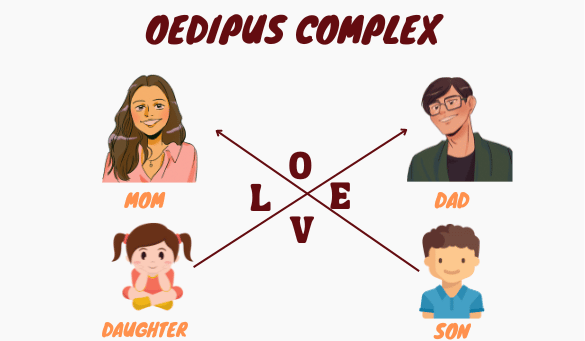
The Oedipus and Electra complexes are a complex emotional and psychological conflict at the heart of the psychoanalytic theory developed by Sigmund Freud, thought to arise during the phallic stage of psychosexual development (roughly ages 3–6). According to the theory, the boy at this stage begins to feel a desire of a sexual nature towards his mother and develops feelings of rivalry and hostility towards his father, whom he sees as the main obstacle to this desire. The conflict is resolved through “castration anxiety”, the fear of being castrated by the father: the boy represses his desire for his mother, identifies with his father and internalises his moral values (the superego). In the female version, which Carl Jung named the “Electra complex”, the girl’s initial attachment to her mother is said to turn towards her father because of “penis envy”; she sees her mother as a rival, and the complex is resolved more slowly and less completely. These complexes, thought in psychoanalytic theory to explain the origins of personality development, sexual identity and neurosis, have been heavily criticised from within psychology and by feminist and anthropological circles since they were first proposed. This article offers a comprehensive analysis of the theoretical framework of the Oedipus and Electra complexes, their mechanisms of resolution, their clinical meaning and the main criticisms levelled at them, together with modern psychodynamic perspectives.
The Oedipus and Electra complexes: a cornerstone of psychoanalytic theory and modern criticism
1. Introduction
Few concepts in the history of psychology have taken such a hold on popular culture, or provoked such intense debate, as the Oedipus complex, which Sigmund Freud named after Sophocles’ tragic king. For Freud, the Oedipus complex was far more than a story of sexual desire: it was a universal developmental turning point that every individual passes through, the fundamental drama of the human psyche. This drama contains a complex scenario of love, jealousy, hatred, rivalry, prohibition and identity formation. Freud claimed that successfully resolving this universal conflict lays the foundation for a healthy adult personality, moral development (the superego) and sexual identity, and that failing to resolve it is the main source of neurotic symptoms in adulthood (Freud, 1924).

While the Oedipus complex is central for the boy, the process described for the girl, later named the “Electra complex” by Carl Jung after another mythological figure, has remained more controversial and less developed theoretically. This article aims to consider the Oedipus and Electra complexes in their original place within psychoanalytic theory, to detail how they work and are resolved, to touch on their clinical significance and, finally, to present the strong scientific, feminist and cultural criticisms of these concepts together with modern psychodynamic perspectives.
2. The Oedipus complex: the boy’s developmental drama
In Freud’s theory, the Oedipus complex appears in the phallic stage, the third stage of psychosexual development (roughly ages 3–6).
2.1. The phallic stage and sexual discovery. At this stage the focus of libido (psychosexual energy) is the genital area. Children discover their genitals and become curious about sexual differences. For the boy, the penis is a great source of pride and pleasure, and his thinking begins to revolve around the presence or absence of genitals.
2.2. Desire for the mother and rivalry with the father. According to Freud, the boy at this stage begins to feel intense, possessive desires of a sexual (incestuous) nature towards his mother, his first love object. He wants all her love and attention for himself and is uncomfortable sharing her with his father. This puts him in rivalry with his father, who is perceived as a powerful rival who steals the mother’s love and disrupts the child’s exclusive union with her. While the boy loves and admires his father, he also harbours unconscious hostile feelings that wish him gone.
2.3. Castration anxiety. The turning point comes when the child realises this rivalry could have dangerous consequences. According to Freud, when the boy notices that girls do not have a penis, he thinks they once had one but lost it as a punishment. He fears that his father will notice his hostile feelings and his desire for his mother and, in retaliation, deprive him of his penis, that is, castrate him. This intense fear, called “castration anxiety”, is the main force driving the resolution of the Oedipus complex.
2.4. Resolution: identification and the birth of the superego. Unable to cope with the overwhelming fear created by castration anxiety, the child must find a way out of this impossible situation. The solution comes through a two-step mental manoeuvre:
- Repression: the child pushes his incestuous desire for his mother and his hostility towards his father into the unconscious.
- Identification: the child gives up his rivalry with his father and begins to identify with him. Trying to be like his father, he internalises his rules, values and moral standards, following the logic “if I can’t beat him, I’ll become like him”. Through this identification, the child takes his father’s moral authority into his own mind, and this internalised authority forms the superego, the moral judge of the personality.
With the resolution of the Oedipus complex, the child’s sexual identity (being like a man) is consolidated and the superego, the inner representative of social rules, develops.
3. The Electra complex: the girl’s developmental journey
Freud described the girl’s development as parallel to the boy’s but more complex and problematic. Although Jung popularised the term “Electra complex”, Freud never fully adopted it and generally preferred to speak of the “female Oedipus complex”.
3.1. Penis envy. The girl’s drama begins when she realises she does not have a penis. According to “penis envy”, one of Freud’s most criticised concepts, the girl perceives herself as “lacking” or “defective” and blames her mother for this (because her mother gave birth to her lacking, like herself). This disappointment leads her to turn away from her mother, her first love object, and direct her love towards her father.
3.2. Desire for the father and rivalry with the mother. The father, as the figure who has the desired penis, becomes the girl’s new love object. She hopes to make up for her lack by having a child with her father. At this point the mother becomes a rival who wins the father’s love, and the girl enters into rivalry with her.
3.3. Resolution and female identity. According to Freud, the girl’s complex is not resolved as clearly and decisively as the boy’s. Because she does not experience the sudden castration anxiety the boy does, she lacks a strong motivation to leave the complex behind, and resolution happens more slowly and passively. Over time, realising she cannot have her father, the girl represses this desire and identifies once again with her mother to learn the feminine role. Freud claimed that, because of this less definite and less complete resolution, women have a weaker superego, a less developed sense of justice and a more narcissistic structure than men, claims for which he has been heavily criticised (Freud, 1931).
4. Criticisms and modern perspectives
Although the Oedipus and Electra complexes are cornerstones of psychoanalysis, there are serious doubts about their validity and universality.
4.1. Feminist criticism. The strongest criticisms have come from feminist thinkers. Psychoanalysts such as Karen Horney (1926) argued that “penis envy” was entirely the product of a male-centred (phallocentric) perspective. Horney proposed that women do not feel a biological lack; on the contrary, men experience an unconscious “womb envy” of women’s capacity for pregnancy and motherhood. In her view, women’s feelings of inferiority are not biological but the result of the secondary roles assigned to them by patriarchal society. More recent theorists such as Nancy Chodorow have explained identity development through the dynamics of the early mother–child relationship rather than sexual conflict.
4.2. Scientific and anthropological criticism. Scientifically, it is almost impossible to provide concrete, testable evidence for the existence of these complexes. The concepts rely less on directly observable facts than on the therapist’s interpretations of patients’ accounts and retrospective reconstructions. In addition, researchers such as the anthropologist Bronisław Malinowski (1927), working in societies such as the Trobriand Islands, where the father is not the main authority figure in the family, argued that the Oedipus complex is not universal. In these societies the authority figure was the maternal uncle, not the father, so the child’s conflict was with the uncle rather than the father. This suggests that the complex is less a biological necessity than the product of a particular family structure.
4.3. Modern psychodynamic approaches. Most psychodynamic therapists today do not treat the Oedipus complex as the concrete, sexual drama of Freud’s original account. They use the concept in a more metaphorical and symbolic sense. On this modern reading, the Oedipal stage is a developmental phase in which the child moves from a dyadic relationship (mother and child) to triadic relationship dynamics. The child learns that the parents have a special bond that does not include them, that they are not at the centre of the world and that love must be shared. Learning to cope with the feelings of exclusion, jealousy and rivalry that arise in this process lays the foundation for healthy relationships. This interpretation moves away from the complex’s sexual and biological reductionism and reframes it as a universal relational developmental task.
5. Conclusion
The Oedipus and Electra complexes are among the most provocative and enduring legacies of psychoanalytic thought. Freud’s original formulations have largely lost their validity today, particularly because of their assumptions about female psychology and the lack of scientific evidence. Concepts such as penis envy are now regarded as historical footnotes. Yet the underlying drama, a child’s struggle for love, belonging, rivalry and identity within the family triangle, remains a central theme of psychological development. Modern psychodynamic therapies use these Oedipal themes not as a sexual scenario but as a valuable metaphor for understanding the complexity of the child’s social and emotional world and the development of their relational capacity. The Oedipus and Electra complexes therefore survive not as concrete realities but as powerful myths that hold the tragic and transformative potential of being human. For more information, please contact us.
6. References
- Freud, S. (1924). The Dissolution of the Oedipus Complex. In The Standard Edition of the Complete Psychological Works of Sigmund Freud, Vol. XIX (1923–1925), pp. 173–179. Hogarth Press.
- Freud, S. (1931). Female Sexuality. In The Standard Edition of the Complete Psychological Works of Sigmund Freud, Vol. XXI (1927–1931), pp. 221–243. Hogarth Press.
- Freud, S. (1905). Three Essays on the Theory of Sexuality. In The Standard Edition of the Complete Psychological Works of Sigmund Freud, Vol. VII (1901–1905). Hogarth Press.
- Horney, K. (1926). The flight from womanhood: The masculinity-complex in women, as viewed by men and by women. International Journal of Psycho-Analysis, 7, 324–339.
- Jung, C. G. (1913). The Theory of Psychoanalysis. Nervous and Mental Disease Publishing Co.
- Malinowski, B. (1927). Sex and Repression in Savage Society. Routledge & Kegan Paul.
- Mitchell, S. A., & Black, M. J. (1995). Freud and Beyond: A History of Modern Psychoanalytic Thought. Basic Books.
This page is for information only and does not replace diagnosis or treatment. If you have similar symptoms, please consult a mental health professional.

Your psychiatrist
Prof. Dr. Ali Keyvan
Prof. Dr. Ali Keyvan is a psychiatrist and psychotherapist. He practises, teaches and supervises cognitive behavioural and dialectical behaviour therapy as well as psychodynamic therapy and group analysis, and is a founding member of the Istanbul Group Analysis Association (IstGA). He sees clients at his clinic in Nişantaşı, Istanbul, and online.


