Clinical writings
Sibling Relationships
Birth order, sibling rivalry, the Cain complex, family roles and attachment: how sibling relationships shape who we become.
 Prof. Dr. Ali KeyvanPsychiatrist and Psychotherapist · Updated: 27 September 2021

Below you will find a scientific article that examines sibling relationships, a subject both universal and deeply personal, through the core theories of psychology and from a psychiatrist’s perspective.
Smadar Ashuach (2012), a clinical psychologist, supervisor, training analyst and group analyst, notes in an article on siblings* that the psychoanalytic literature on this subject is sparse, while also pointing to how it has grown richer over time.
Why, then, have sibling relationships, which emerge so clearly in groups and can be explored in depth in group analysis (psychoanalytic group therapy), perhaps not found the place they deserve in the psychoanalytic literature?
Ashuach explains this through the horizontal nature of sibling and peer relationships, in other words their lack of the vertical transference that refers back to the parent–child relationship.
The author chose the title “Am I my brother’s keeper?” for the article. Taking the reader to the story of Cain and Abel, and from there to sibling jealousy and fratricide, the title arouses curiosity about an article that discusses how sibling traumas, smaller reflections of these tragedies, are worked with in the analytic group, and how repair thereby becomes possible.
This paper, which holds an important place in the group analysis literature, has not yet been translated into Turkish; for interested colleagues, the reference is:
*Smadar Ashuach. Am I My Brother’s Keeper? The Analytic Group as a Space for Re-enacting and Treating Sibling Trauma. Group Analysis, 45(2), 155–167. First published 22 May 2012.
The psychodynamics of sibling relationships
Author: Prof. Dr. Ali Keyvan, Psychiatrist
Abstract
The sibling bond, one of the longest-lasting and most formative relationships in human life, is a complex dynamic that can fuse the most positive feelings, such as love, support and companionship, with the most destructive, such as jealousy, rivalry and anger. It leaves deep marks on countless areas of life, from identity development and social skills to choice of partner and parenting style. This article examines the many layers of sibling relationships in the light of the main theoretical frameworks of psychology: Alfred Adler’s concepts of birth order and family constellation, Sigmund Freud’s Oedipal rivalry and the “Cain complex”, family systems theory’s emphasis on roles and boundaries, the effects of John Bowlby’s attachment theory on the secure base and the arena of rivalry, and Albert Bandura’s social learning theory with its ideas of modelling and the sibling relationship as a social laboratory. An integrative assessment of these theories offers clinicians a foundation for understanding the deeper dynamics beneath conflicts and bonds between siblings and for planning therapeutic interventions more effectively.
Keywords: sibling relationships, sibling rivalry, birth order, psychoanalysis, family systems, attachment theory, Alfred Adler.

Theoretical approaches along a spectrum from rivalry to support
1. Introduction
The sibling relationship is different by nature from every other relationship in a person’s life: it is unchosen, involuntary and usually lifelong. Siblings who share the same parents, the same genetic and cultural heritage and the same home can be each other’s closest allies and fiercest rivals. In clinical practice we often see unresolved childhood sibling dynamics at the root of many adult neurotic conflicts, relationship problems and difficulties with self-esteem. Understanding a person’s experience as a sibling is therefore essential to understanding their inner world.
2. Theoretical approaches
2.1. Adler and individual psychology: birth order and the stage of rivalry
Perhaps the most important theorist to place sibling relationships at the centre of his theory is Alfred Adler. For Adler, parental love and attention are like a “cake” that siblings share, and each sibling struggles to get the biggest slice. The most important factor shaping each child’s strategy in this struggle is birth order:
The first child: at first the “sole heir to the throne”, they experience the trauma of the “dethroned king” when the second child is born. They tend to be more rule-bound, responsible, perfectionistic and eager for parental approval, and represent the power and authority of the past.
The middle child: always finds themselves “sandwiched”, with neither the privileges of the eldest nor the luxury of being the youngest’s centre of attention. This can make them more competitive, ambitious, diplomatic and inclined to mediate, and highly sensitive to unfairness.
The youngest child: as the family’s “baby”, usually receives more attention and affection. This can make them more creative, sociable and outgoing, but also more rebellious or dependent. They feel freer to find their own way.
The only child: never having experienced sibling rivalry, they may find sharing and cooperation harder. They communicate more easily with adults, may be more mature than their peers and are used to being the centre of attention.
Adler stresses that birth order is not deterministic; what matters is how the child subjectively interprets their position.
2.2. The psychoanalytic approach: Oedipal rivalry and the “Cain complex”
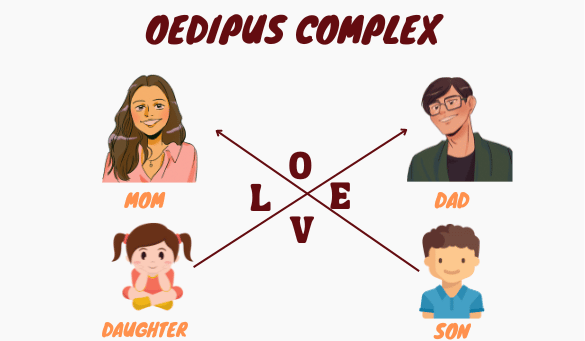
For Sigmund Freud, the main stage of the family drama is the Oedipus complex: the child’s desire for the parent of the opposite sex and rivalry with the parent of the same sex. Siblings are secondary but important players in this drama; they are direct rivals for parental love and attention. Freud’s account of this primitive hatred and jealousy is often described as the “Cain complex”, after the myth of Cain, who killed his brother Abel. From a psychoanalytic perspective, one sibling’s intense anger towards another is really a reflection of the fear of losing the parent’s love.
2.3. Family systems theory: roles and boundaries
Theorists such as Murray Bowen and Salvador Minuchin move the problem from the individual to the family system as a whole. In this view, siblings take on particular roles to preserve the family’s balance (homeostasis): “the successful child”, “the scapegoat”, “the sick child”, “the clown” and so on. The role one sibling takes on directly affects the roles of the others. Conflict between the parents can create “triangulation”, in which a child is drawn in to reduce tension, leading to unhealthy alliances or hostility between siblings.
2.4. Attachment theory: secure base and arena of rivalry
According to John Bowlby’s theory, the attachment style a child forms with the primary caregiver (usually the mother) is the prototype for all future relationships.
Secure attachment: children who are sure of their parents’ love and presence are less likely to see a new sibling as a threat; they do not experience parental love as a field of competition.
Insecure attachment: when parental attention is inconsistent or inadequate, siblings compete fiercely for this limited resource. Sibling rivalry is usually most intense in families dominated by insecure attachment patterns. Where parents are neglectful, an older sibling may also become a “secondary attachment figure” for a younger one and take on a protective role.
2.5. Social learning theory: the first peer, the first model
According to Albert Bandura’s theory, siblings are each other’s most important social models. Children first learn and try out basic social skills such as resolving conflict, negotiating, empathy, aggression and cooperation in their interactions with siblings. The sibling relationship serves as life’s first “social laboratory”.

3. Conclusion
Sibling relationships are a fundamental force shaping a person’s psychological DNA. In clinical assessment, looking beyond the question “does this person have siblings?” to questions such as “what was their position in the family constellation?”, “how did they experience sibling rivalry?” and “what roles did the siblings take on in the family?” opens an invaluable door to their inner world. In treatment, understanding how these early rivalries and bonds are reflected in present relationships and symptoms forms the basis of therapeutic change.
4. References (key works for further reading)
Adler, A. (1927). Understanding Human Nature.
Freud, S. (1913). Totem and Taboo.
Bowen, M. (1978). Family Therapy in Clinical Practice.
Minuchin, S. (1974). Families and Family Therapy.
Bowlby, J. (1988). A Secure Base: Parent-Child Attachment and Healthy Human Development.
Bandura, A. (1977). Social Learning Theory.
Harris, J. R. (1998). The Nurture Assumption: Why Children Turn Out the Way They Do.
This page is for information only and does not replace diagnosis or treatment. If you have similar symptoms, please consult a mental health professional.

Your psychiatrist
Prof. Dr. Ali Keyvan
Prof. Dr. Ali Keyvan is a psychiatrist and psychotherapist. He practises, teaches and supervises cognitive behavioural and dialectical behaviour therapy as well as psychodynamic therapy and group analysis, and is a founding member of the Istanbul Group Analysis Association (IstGA). He sees clients at his clinic in Nişantaşı, Istanbul, and online.